
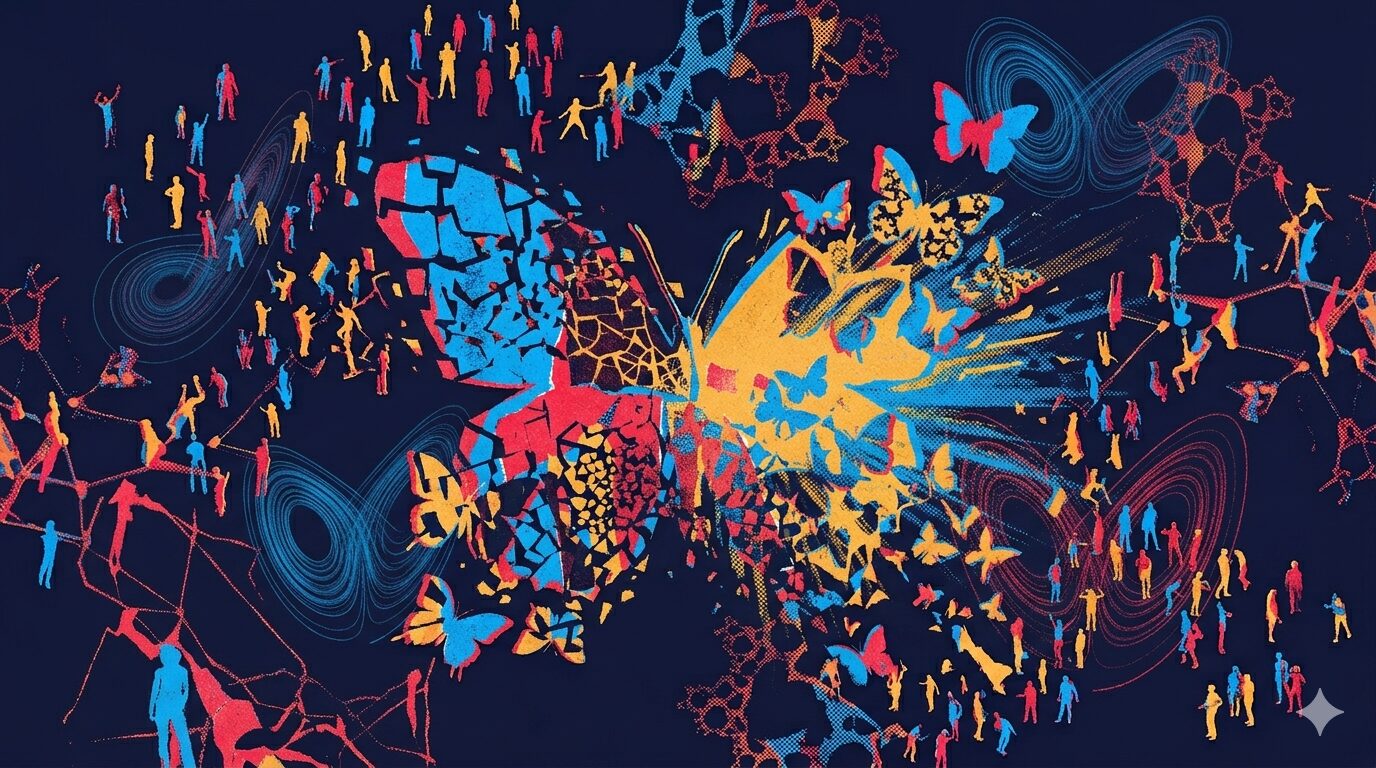
On Saturday, March 28, 2026, over 8 million people took to the streets across 3,300 “No Kings” protests in the United States and beyond. They came without permission from authorities, without corporate sponsors, without hierarchy or centralized command. In living rooms and organizing meetings, they shared why: to resist authoritarianism, to fight the Trump administration’s immigration crackdown, to oppose war in Iran, to defend voting rights. But what many didn’t fully understand—what they embodied—was a profound principle that chaos theory and political philosophy both illuminate: unpredictability is the mechanism of freedom.
The spontaneity of the No Kings movement is not a weakness. It is its greatest strength.
The Butterfly Effect of Mass Protest
Chaos theory teaches us that complex systems are exquisitely sensitive to initial conditions. A tiny change in one variable ripples through the entire system in ways that are impossible to predict in advance. Edward Lorenz discovered this in the 1960s when a rounding error in a weather simulation produced drastically different results—hence the metaphor of a butterfly’s wings in the Amazon causing a hurricane in Texas.
Social movements operate as complex, nonlinear systems. When 8 million people spontaneously organize across thousands of independent nodes—without a single command center, without a fixed playbook, without predictable timing—they become uncontrollable. Authorities, algorithms, and power structures depend on knowing what comes next. They prepare for the expected march. They position police at anticipated chokepoints. They craft counter-narratives for predicted grievances. But when a movement is truly decentralized and emergent, when every organizing meeting generates unexpected variations on themes, when each local protest adapts to local conditions, the system becomes chaotic in the mathematical sense: deterministically unpredictable.
This is not anarchy. It is emergent order arising from distributed agency.
Timothy Snyder’s Insight: Unpredictability as Freedom
The historian and political philosopher Timothy Snyder, in his recent work On Freedom, offers a crucial thesis: freedom is not the absence of constraints, but the capacity to escape predictability. Authoritarianism, he argues, functions through the elimination of surprise. Totalitarian states work by modeling human behavior, predicting reactions, and closing off unexpected paths. When the regime can anticipate your next move—when your movements are funneled through surveillance, algorithms, and predetermined roles—you have lost freedom, even if you haven’t been imprisoned.
Unpredictability, in this framework is the core mechanism of liberty.
The No Kings movement, in its spontaneity and its decentralized coordination, embodies this principle. A person in rural Minnesota organizes differently than a person in Brooklyn. What emerged in Saint Paul was unpredictable. What emerged in Los Angeles was unpredictable. The intersection of these thousands of independent decisions created a cascade of effects that no central authority could have foreseen or fully controlled.
When an authoritarian regime cannot predict the timing, location, or nature of mass action, it faces a crisis. Control requires predictability. The regime can deploy police to suppress an expected march, but when protests are genuinely decentralized—when the movement regenerates constantly, when “What’s Next” organizing meetings generate new tactics weekly—the apparatus of control becomes reactive rather than proactive. It chases a moving target.
The Architecture of Chaos
The No Kings movement’s structure—or rather, its lack of rigid structure—is itself a strategic choice informed by chaos theory, whether explicitly or intuitively:
Decentralized nodes: Thousands of independent organizing groups means there is no kill switch. Remove one leader, and dozens more emerge. This is a fractal pattern: self-similarity at different scales, each cell capable of regeneration.
Feedback loops: Each protest learns from the previous one. Tactics that worked in June 2025 are modified in October. October’s lessons are evolved again by March 2026. This iterative process is the hallmark of systems-thinking and chaos-informed strategy.
Sensitivity to initial conditions: Small decisions ripple outward. One organizer’s choice to focus on ICE leads to massive mobilization in Minnesota. That success becomes a story that inspires elsewhere. A chant invented in one city spreads to dozens. The system is sensitive to these small variations, amplifying them.
Emergence without central direction: No one person planned for 8 million to show up. The movement emerged from distributed decisions, each person contributing agency. The final outcome could not have been predicted from any individual decision. This is emergence in the technical sense: complexity arising from simple rules applied locally, without top-down command.
Control Through Predictability, and What Authoritarians Fear
Authoritarian regimes invest heavily in prediction: surveillance states, data collection, algorithmic control. The goal is not merely to punish dissent—it is to make dissent impossible by eliminating surprise. When the state knows where you are, who you communicate with, what you’re likely to do, the space for freedom contracts.
This is why the Trump administration’s approach to protest includes attempts at prediction and control: designating certain sites as off-limits, flooding areas with police in advance, attempting to co-opt or preempt narratives. These are tools of a system trying to manage unpredictability.
But when a movement genuinely embraces chaos—when it is truly decentralized, when each local node makes authentic decisions, when the whole is not controlled by the parts—it escapes this trap. The regime can prepare for what it expects. It cannot prepare for what it cannot predict.
Small Changes, Large Outcomes
Snyder emphasizes that in a chaotic system, small acts of unpredictable freedom matter immensely. A person who votes unexpectedly. A group that organizes locally rather than following a predetermined script. A protest that happens in a small town where no one predicted it would. Each of these is a small perturbation in the system.
In a linear system, these perturbations would be noise—meaningless. But in a complex system, in a chaotic system, they propagate. The woman in rural Kansas who organizes the first No Kings rally in her county is not a small player. She is a node in a fractal distribution. Her local decision becomes part of the emergent whole. Suddenly, the movement is 3,300 protests, not 3,299. The distribution has shifted. The pattern has changed.
This is the butterfly effect applied to activism: tiny local decisions, aggregated across a decentralized network, producing system-level changes that no authority could have predicted or entirely controlled.
The Risk of Capture
There is a vulnerability: when movements succeed, power attempts to co-opt them, to make them predictable, to turn them into a machine. Movements that develop hierarchies, that centralize, that become knowable and controllable, lose their power.
The challenge for the No Kings movement—and it is a real challenge—is to maintain its chaos. To resist the urge to centralize. To keep regenerating unexpected forms. To honor that May 1st Mayday organizing meetings will produce unknown variations. To trust that the “What’s Next” organizing meetings will generate unpredictable futures.
Because the moment a movement becomes predictable, it becomes controllable. And the moment it becomes controllable, it is no longer free.
Conclusion: Embracing Chaos as Freedom
Eight million people did not need permission. They did not need a centralized plan. They did not need to be told what to think or what to chant. The movement emerged from distributed human agency—millions of decisions, unpredictable in their specifics, coherent in their thrust.
This is what Timothy Snyder means when he insists that unpredictability is essential to freedom. It is not freedom in the sense of “anything goes.” It is freedom in the sense of the capacity to escape predictability, to refuse the scripts that power has written, to make choices that authorities did not anticipate.
Chaos theory, in this light, is not a description of disorder. It is a map of how freedom actually works: through distributed agency, through sensitivity to small changes, through the irreducible emergence of order from the interplay of millions of independent decisions.
The No Kings movement got one thing right: there are no kings. And in the spontaneous coordination of millions of people, each making unpredictable choices in their own context, there emerges a power that authoritarianism cannot fully capture, cannot fully predict, cannot fully control.
That is chaos. That is freedom. That is the real danger to those who would be Kings.
Leave a Reply