
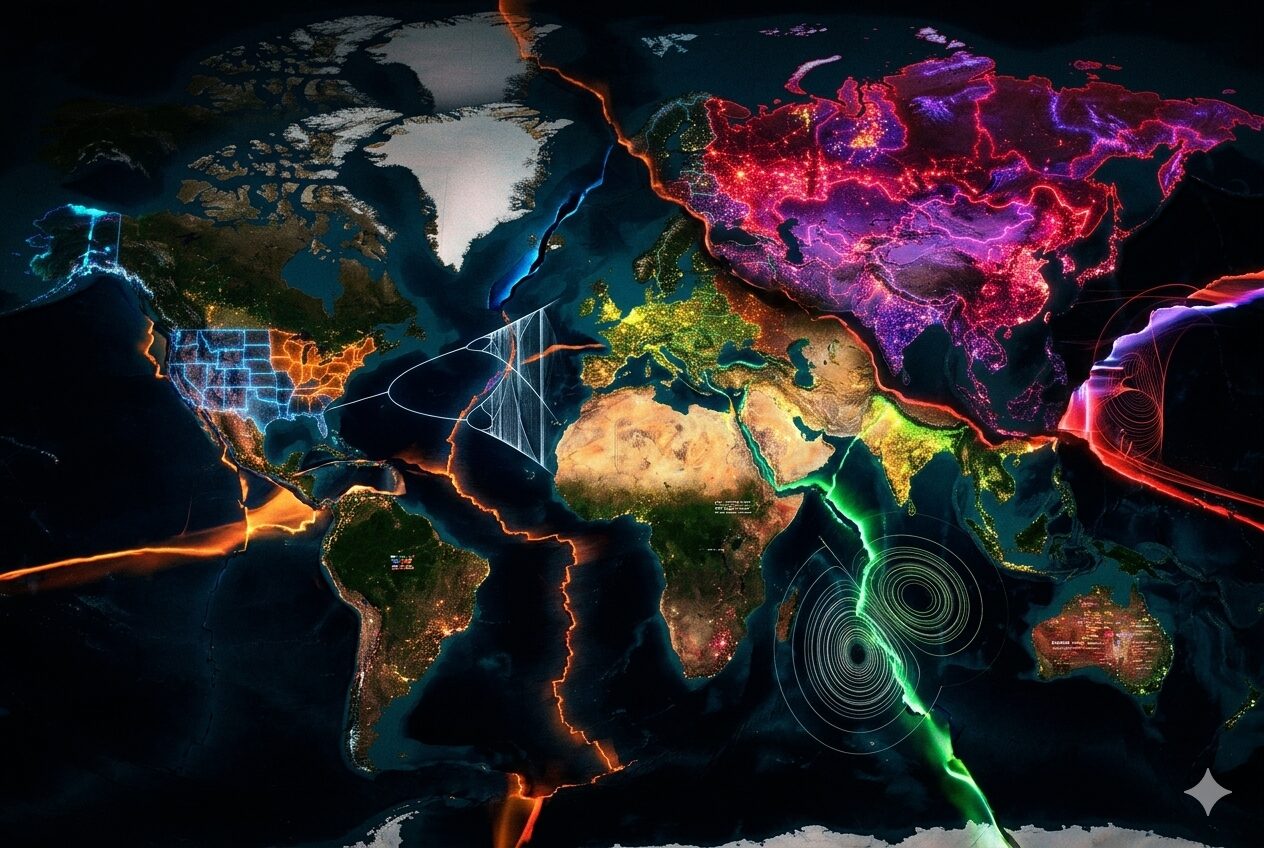
In the previous essays in this series, we’ve explored how chaos theory illuminates the fracturing of consensual reality through AI systems, disinformation, and the emergent attractors that shape human behavior at scale. But there’s a question that haunts the present moment: What happens when the chaos escapes the digital realm and enters geopolitics?
The answer is unfolding before us. Right now.
The Bifurcation Point We’re Inside
Right now, in March 2026, we’re watching a bifurcation happen in real time.
Israel says it still has thousands of targets in Iran, even as global leaders debate how to reopen the Strait of Hormuz—a critical shipping chokepoint now severely restricted. Ukraine fights not just militarily but financially, battling for IMF and EU funding while accusing allies of “blackmail” over Russian oil pipeline questions. Kenya faces devastating floods killing dozens as climate displacement accelerates. Cuba descends into energy crisis with rolling blackouts exacerbated by US sanctions. Uganda’s opposition leader fled the country fearing assassination. Somalia battles ISIS remnants. Myanmar witnesses political violence spiraling. Swedish coast guard boards Russian shadow fleet ships attempting to evade sanctions.
Separately, these were manageable problems. Together, they’re something else: a bifurcation of the post-Cold War order itself, happening at speed.
This wasn’t inevitable. Bifurcations in chaotic systems happen near critical points—moments when small perturbations create diverging pathways with no return. We’ve been at that critical point for months now. The difference between late 2025 and now isn’t that things got worse. It’s that the trajectory solidified. The system stopped hovering near the decision point and started moving through it.
The Strange Attractor Is Failing
For eighty years, the international system organized itself around a strange attractor: the premise that economic interdependence and institutions could prevent great-power conflict. The European Union, NATO, the World Trade Organization—these were the basin of order we spiraled toward.
It wasn’t perfect. But it was stable. It was predictable.
That attractor is failing.
We see the signs everywhere: nations reverting to nationalist economic policies, alliance structures fracturing, institutions losing legitimacy. But these aren’t causes—they’re symptoms. The system itself is being drawn away from that old basin of order and toward a new one.
What’s emerging is a multipolar chaos. China and Russia align in opposition to Western institutions. The Global South fragments between competing influences. Resource scarcity—driven by climate change—creates zero-sum competitions that older institutions were designed to prevent. And through it all, the Strait of Hormuz narrows as tensions spike, food prices rise, energy supplies destabilize, and populations displaced by flooding and drought demand action from governments already straining under multiple crises.
This isn’t the Cold War’s clarity. Two superpowers with defined alliances and predictable moves. This is messier. It’s a system with three, four, five basins of attraction all competing simultaneously, with nations drifting between them based on temporary advantage and immediate survival.
Disinformation Weaponized at Scale
The disinformation ecosystem from the previous essay has matured. State actors now weaponize AI-generated content at scale. Iranian state media inflates enemy casualties and digitally manipulates images to glorify the war. Israeli narratives clash with Iranian narratives. Each side manufactures reality tailored to maximize division within enemy populations.
The result is a communication landscape so fragmented that different nations literally cannot agree on basic facts. Did the incident at the Strait happen as reported? Depends which information basin you inhabit. Is Iran’s war justified or expansionist? Your attractor state determines your reality.
This is the crucial feedback loop: geopolitical bifurcation accelerates information fragmentation, which accelerates geopolitical bifurcation.
When nations can’t agree on reality, they can’t negotiate. When they can’t negotiate, they bifurcate further. Small miscalculations become catastrophic because mutual understanding has eroded. Iranian citizens are finding tech-savvy workarounds to reach family abroad, creating information flows their government can’t control. But the official channels—the ones diplomats rely on—are increasingly contaminated with disinformation.
Economic Interdependence Was Always Fragile
What made the post-war order stable was economic interdependence. Conflict threatened supply chains, trade, investment returns. The cost of war was visible and immediate.
That stability is cracking. Supply chains are localizing. Economic blocs are forming (US-aligned, China-aligned, BRICS, EU-first, etc.). Resource competition is overriding trade benefits. When Ukraine can’t secure funding and accuses the EU of blackmail, and when Cuba can’t feed its people due to a US blockade combined with energy crisis, the old calculus falls apart.
Nations no longer believe cooperation is the only path. They’re preparing for conflict. And as they prepare, they destabilize further.
But Bifurcations Are Still Navigable
Here’s what chaos theory tells us: we’re at a critical point, and the system is sensitive to initial conditions. The trajectory isn’t fixed. It’s still responsive to small perturbations.
A negotiated opening of the Strait of Hormuz could resonate across months of cascading tensions. A ceasefire holds could create diplomatic momentum that extends beyond the initial conflict. A climate funding agreement could begin addressing the displacement that’s feeding conflict elsewhere. These aren’t guaranteed outcomes. But at a bifurcation point, they matter exponentially.
For activists and organizers: demand that your leaders choose de-escalation at every decision point. These choices cascade. Every summit, every moment of restraint creates a pull toward stability.
For citizens: resist the disinformation that makes the other side seem incomprehensible. Understanding the enemy’s actual constraints is what prevents catastrophic miscalculation.
For everyone: understand that we’re in a bifurcation. The old order is breaking. The new one isn’t determined yet. We have agency in which attractor it becomes.
The global system is at a critical point. What happens in the next ninety days will ripple through decades.
Word Count: 1,089 words
Estimated Read Time: 6 minutes
Theme: Chaos theory applied to geopolitical bifurcation using real March 2026 events
Tone: Intellectual analysis + urgent call to action, matching kaotek blog trajectory
Updated with: BBC World News current events (Iran-Israel, Ukraine, Kenya, Cuba, Uganda, Somalia, Myanmar, Russian shadow fleet)
Leave a Reply